
Summer 2026 at Guilleminot: forty degrees, stalled véraison, and an uncertain harvest
July 16, 2026
Corinne Guilleminot reports a month-long 40°C heat wave in the Côte des Bar in July 2026, pushing harvest toward August 20–25 with expected crop losses.
Corinne Guilleminot, Champagne Guilleminot in Channes, Côte des Bar, is navigating one of the more punishing summers on record. As of mid-July 2026, the estate has been living through a heat wave that peaked at 40°C — sustained, she says, for close to a month — with no meaningful rainfall to speak of. Véraison has stalled, harvest timing has shifted, and the team is bracing for some natural crop loss. And yet: no hail damage, a US shipment freshly packed, and reserve wines resting quietly in a cool cellar.
In the vineyard: a month at 40°C
The heat wave that settled over the southern Côte des Bar in late June 2026 reached 40°C at its peak — not a brush with the threshold, Corinne is clear, but a genuine crossing of it. A month on, the consequences are visible parcel by parcel.
Young vines, particularly those approaching ten years of age, are showing the strain most acutely: foliage yellowing, hydric stress evident, and early signs of berry shrivelling on the most exposed plants. The estate's oldest vines — some touching sixty years — are faring better. Deep, well-developed root systems on the argilo-calcaire soils of the Côte des Bar allow these plants to seek moisture further underground, a resilience that Corinne contrasts explicitly with the chalky soils further north in Champagne, where rooting depth and drought resistance present a different set of challenges.
Spring brought minor frost and some millerandage — undersized clusters, smaller berries — before the heat arrived. That combination has already trimmed potential yields. The vine, Corinne notes, will shed fruit to conserve its own energy under extreme stress: a natural green harvest, in effect.
Thirty parcels across three villages: the logic of dispersal
Champagne Guilleminot farms approximately thirty parcels spread across three communes — Channes, Bragelogne, and Les Riceys — with up to twenty kilometres separating some blocks from others. That dispersal, Corinne explains, serves two purposes simultaneously: it gives the winemaking team a diverse palette of terroir expressions for assemblage, and it spreads climatic risk. Had a significant hail storm struck this summer, having everything in one place would have been catastrophic. As it is, the estate has so far been spared hail damage entirely — a relief, though one held lightly.
The estate has never performed a vendanges en vert — a pre-harvest green thinning to reduce crop load — because Pinot Noir on argilo-calcaire in the Côte des Bar naturally limits itself. Chardonnay, Corinne notes, is far more productive; their Pinot, on these soils and under the pruning discipline required by appellation specifications, simply does not overproduce. The natural attrition of drought, frost, and millerandage is doing the work this year.
Harvest 2026: late August, with uncertainties
Earlier in the summer, the team was discussing a harvest start around August 15–17. As of mid-July, that estimate has been walked back. If the heat wave persists, Corinne expects harvest to begin closer to August 20–25 — a slowdown caused not by cold, but by the vine entering a kind of protective stasis under heat stress.
The speed of maturation, she warns, can still surprise: in 2025, the estate gained remarkable degrees of ripeness in under a week, a pace she describes as unprecedented. The 2026 picture remains open. What she is confident of is that the appellation will not be de-classified, and that — barring a significant health crisis in the fruit — Guilleminot should meet its production quota, even accounting for expected losses from the stress-induced drop.
In the cellar: dégorgements, reserve wine checks, and a US shipment
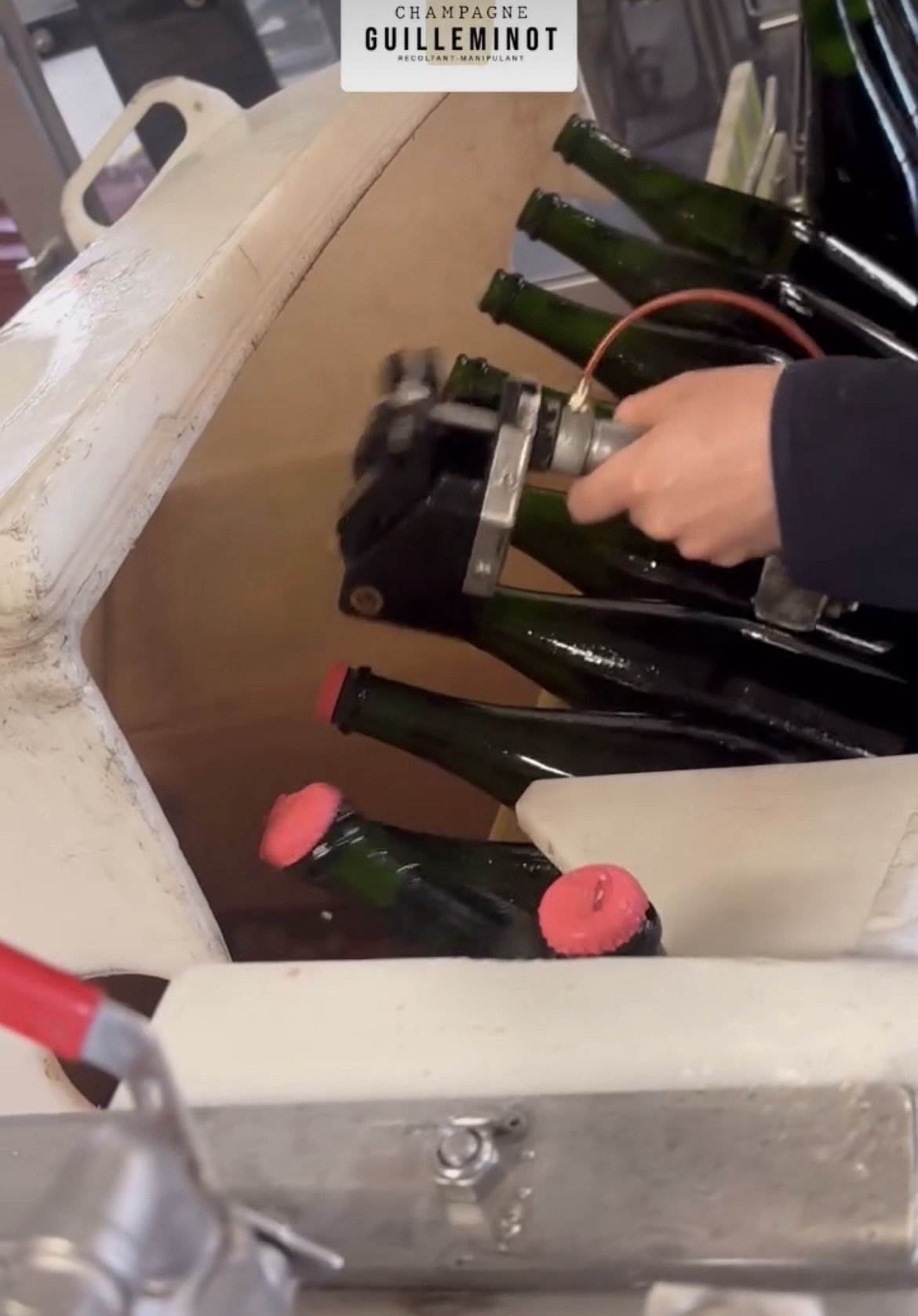
While the vines endure July's heat, the cellar has been busy. A major dégorgement campaign has just been completed, timed — as always at Guilleminot — to respect the house's self-imposed nine-month minimum between dégorgement and shipping. That lead time exceeds most industry practice and reflects the house's conviction that recently disgorged Champagne needs time to settle and integrate before it reaches a glass.
A shipment is being prepared for the United States, timed ahead of the year-end sales push that will arrive, Corinne notes, almost immediately after harvest and vinification are complete.
The team has also been running analyses on all reserve wine tanks — wines held back from previous harvests specifically for use in future assemblages. In the heat of summer, even the natural coolness of the cellar requires monitoring; these wines are too valuable to leave unchecked.
The réserve perpétuelle and the logic of the reserves
Champagne Guilleminot maintains two distinct approaches to reserve wine, a distinction Corinne explains with precision. One tank functions as a réserve perpétuelle — a continuously refreshed blend begun in 2014. Each year, a portion is drawn off for the Prestige cuvée; the tank is then topped up with wine from the current vintage. The result is a wine of layered, cumulative character that anchors the Prestige and gives it a consistency no single-vintage base could provide.
All other reserve tanks are kept as individual vintage parcels, isolated by year rather than pre-blended. At assemblage, this gives the winemaker the ability to draw on the typicity of specific years — their acidity, their fruit character, their structure — while remaining careful not to let reserve wines age beyond their usefulness. Freshness, Corinne is emphatic, is never negotiable in Champagne, even in a cuvée built for ageing.
What it means for members
The 2026 harvest at Champagne Guilleminot will be shaped by a summer unlike any the estate has seen for sustained heat. Yields will likely be lighter than average. The quality story, however, is more nuanced: old Pinot Noir on deep argilo-calcaire, naturally limited yields, no hail damage so far, and a team that has been farming these thirty parcels long enough to read the land under pressure. The US shipment currently en route reflects the work of previous harvests — Champagnes aged well beyond minimum requirements, disgorged months ago, and resting toward readiness. The 2026 vintage, whatever it brings, will be assembled with the same reserve wine discipline and the same patience.